star counter


View My Stats
Powered By Blogger

Monday, December 20, 2010

The eruption of Mount Merapi Central Java 2010


Mount Merapi
Located just a volcanic stone’s throw from my house on the northern outskirts of Jogyakarta in the central province on the island of Java is the world’s most active volcano. It is also home for tens of thousands of villagers whose families have lived there for centuries. The rich volcanic soil produces abundant food crops ,trees and grasses that support cattle, goats chickens and ducks

The rough river beds gouged out of the mountain by flows of lava are a rich source of mining for dirt, gravel and rocks.


After the eruption vocanic soil blocking this river


In mid October 2000 we heard the first reports of a change in the mountain, the sides were expanding much like bread rising in an oven. Then there were several earthquakes that made our solid two story house shudder. The continual rumbles in indicated pressure was building and the severity of the situation increased in the days leading up to October 26th.Vulcanologists measured the pressure of molten rock and found it to be increasing daily .


On October 25th we had to leave the country to renew our Indonesian visa and we were joined by a large crowd of local Indonesians who also were leaving for fear of the volcano.


on October 26th the first eruption occurred killing 44 people


To understand why people were reluctant to leave their homes there was an interesting article that explains some Javanese traditional thinking

Merapi and Javanese cosmology Reported by the Jakarta post


Volcanic ash


“For years, people there have believed that Merapi would never propel clouds and lava onto its southern slope,. They thought Merapi would not deface its supposed front slope.


But for those people, the unthinkable happened. Huge hot clouds, with energy three times bigger than that of the three previous eruptions in 1994, 2001 and 2006, sped down the mountain and swept over Kinahrejo and the neighboring village of Kaliadem, killing over 40 people including Mbah Maridjan


FAMILY POSSESSIONS DESTROYED


The 3,000-meter high Mt. Merapi, sitting astride the neighboring provinces of Yogyakarta and Central Java, is an important icon in Javanese traditional mysticism and cosmology, especially for Yogyakarta, which is often considered to be at the heart of Javanese culture.
Believed to be the kingdom of the spirits, Merapi has long been seen as the symbol of the balancing elements of the universe forming a straight, sacred imaginary axis from the north — where it is located — to the south where the kingdom of the Queen of the South Sea Ratu Kidul lies, with Yogyakarta Palace at its center.


Followers of Javanese cosmology believe the world is basically a harmony between the microcosmic and the macrocosmic. In this case Merapi and the South Seas Kingdom are considered as the microcosmic while the Yogyakarta Palace the macrocosmic. Both are supposed to be in balance to create harmony.


For traditionalists, Merapi eruptions are a sign that the kingdom of spirits is having a party and the lava expelled is simply garbage left over from the celebration.
This is why they never imagined volcanic material would ever pour down the southern slope, since this would be like dumping rubbish in one’s front yard.


Carrying out the dead


Volcanic dust in the main street Yogyakarta
Raining ash in the main street


JAJARTA POST REPORTED THE FOLLOWING

But somehow, the disaster has also led to priceless moments, creating strong emotional bonds among survivors — turning strangers into good friends within minutes.
Without any publicity or assistance from any groups or political parties, the residents less affected by the disaster led efforts to help survivors.


In the Central Java town of Boyolali, a local motorcycle club raised funds from passing motorists by performing a motorcycle stunt show at an intersection.


In Kauman village in Klaten regency, a group of local women worked morning and afternoon to prepare meals for evacuees in a small shelter near the area.


“When we opened the self-help public kitchen 10 days ago, we were able to make 350 packed meals, three times a day. However, since the donations we received decreased significantly, we can only make 100 meals now,” Theresia Ekowati, the public kitchen’s coordinator, said.


Theresia, who closed her catering business to work in the public kitchen, said she and other residents would try their best to keep providing meals for evacuees despite a lack of funds.


“We are ready to spend our own money if it comes to that,” she said.


In another shelter located at the Magelang military academy shooting range, 18-year-old Mufidhatul Afi never expected she could find a temporary home for her 15-day-old baby girl.


Her fate took a fortunate twist when she met Eri Kusyanti, a housewife from a village just across the crowded shelter.


Eri said that last week, a day after Merapi’s largest eruption, the entire village experienced a blackout.


“Since I desperately needed to charge my cell phone battery, one of my neighbors told me to go to a new shelter nearby that had a diesel generator,” said Eri, whose husband works in Riau.


It was at the shelter that Eri saw a panicked young woman reporting that her newborn baby had a respiratory problem, believed to be caused by volcanic ash.


“My intuition as a mother said I must help them,” Eri said.


Unplugging her half-charged phone, Eri then jumped into an ambulance taking Afi and her baby to the nearest community health center.


After getting medical treatment, Afi and her baby were allowed to return home, but Afi was advised to not expose the baby to ash.


Eri said she invited Afi and her baby to stay at her house.


“I feel so relieved,” said Afi, whose husband works out of town. “I just can’t imagine how I would survive without Eri’s help.”


Afi, whose village is located only 15 kilometers away from Merapi’s crater, now stays with her baby in a room at Eri’s house.


When the Post visited them, Afi was busy washing baby clothes in the bathroom while Eri was lulling her baby to sleep on the terrace.


Eri’s nine-year-old daughter approaches the baby and smiles, carefully stroking the baby’s cheeks in her mother’s arm."


Wild animals leave scorched forests after eruptions


Jakarta post 13th november


“Hundreds of wild animals that previously inhabited forests on the slopes of Mount Merapi began leaving the area as their habitats were completely devastated following eruptions from the world’s most active volcano.


Hundreds of long-tailed monkeys from the scorched Plawangan forest were seen moving out of the area, entering residential areas some 15 kilometers down the slopes. Other animals are thought to have migrated to forests on the slopes of neighboring Mount Merbabu, “We are not sure about the numbers but they’re understandably looking for new habitats and food,” Sartono, the head of the Natural Resources Conservation Center (BKSDA) Regional I overseeing Sleman regency, Yogyakarta city and Kulonprogo regency, said Friday.


Since its first major eruptions on Oct. 26, pyroclastic flows and lava from Merapi have destroyed more than 6,000 hectares of forests on its slopes.


Animal activist Daniek Hendarto said volunteers were providing animals with food and water. “We want to make sure the animals in the [20-kilometer] exclusion zone survive,” he said.


Pyroclastic flows, Sartono said, had also destroyed Javanese eagle nests in Kinahrejo and Kaliurang forests, forcing the birds to leave the area.


The sight of two leopards has also created panic among residents of Kemput village, in Sleman, 11 kilometers from Merapi’s crater. They said they saw the big cats approaching cow sheds.


“It looked like a mother and her cub,” said Sokidi of Kemput.

We returned to Yogyakarta a month after the initial blast. Our house was still covered in ash even though there had been heavy rains. The people were going about their business in a quiet subded way. Our office had become a logistic centre for basic items for the thousands of displaced people in refugee camps. Bags of rice,boxes of underwear, crates of drinking water, packets of noodles and shampoo. Our office grounds housed 10 goats rescued from Merapi Lintas. A radio was set up under the front veranda with a large map on the wall were information gathered from the radio and sms messages was collated.


Dead animals everywhere

WE rode our motor bike up the slopes of Merapi and were amazed at the devastation. The countryside looked like a black and white photgraph taken on the battle field of the Somme during world war I.
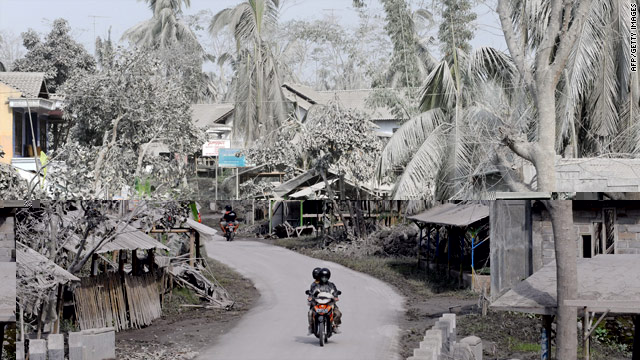
This village is intact

houses completely flattened,trees felled powerpoles down and rivers choked with thousands of tons of sand.

Grass growing  again after six weeks
Greyness of the landsacape


Amidst the devestation people were smiling as they cleared debri,hunted for lost belongings and tended the young shoots of Banana palms and the green stems against the grey landscape demonstated that life continues.
It has been rumourd that The government will move the people affected by the volcano to Sulawesi ! This would be a major disaster if it happens as Sulawesi is a different culture with unfertile soil.
I think local protests will prevent this from happening.
 

Sunday, October 24, 2010

Foreign Aid in Indonesia


ADVENTURES IN FOREIGN AID
 
Why do people volunteer for Aid projects

I guess there is a drive in some people to want to help and to do something worthwhile in their life. Then there is the adventure or an escape from boredom and the other people hanging over their stools at McDonalds.

The selection procedure for volunteers appears professional and quite demanding.

two interviews and a psychological review. However some six months in the field and observing some of the volunteers I have some doubts about quality the selection process.

Two volunteers that I know of have shortened their contracts and one was removed from the country after running foul of both is indigenous boss and the AVI country manager. The other gave a string of weak excuses for going home and told the country manager he could choose any one .

Of the others that I have met some are doing their job well and others are just muddling through.

At the pre departure briefing for Australian Volunteers International I was with 40 other Volunteers participating in a workshop that included looking after yourself physically and mentally, What does it mean to be an Australian and a long session on HIV and aids. The government expected us to be both ambassadors and teachers as we were all teaching something as well as trying to prevent the spread of HIV and aids.

There was an important section on Foreign aid objectives and in one particular exercise where we had to rank in order of importance the following:-

Human rights

Economic development

Environmental issues

Good Governance

Regional Cooperation

Poverty

Education

Women’s rights

Public health

Infrastructure

Try it yourself before you read on.

THE GOAT MARKET AT GARUT


What was interesting was that most people viewed their area of expertise and experience as the most important. The social workers put human rights on the top of the list, the health workers public health and so on .
The reality is that without Good Governence none of the other issues can be dealt with adequately. Good governance not only refers to our beloved politicians but the pubic service and the legal system without which there would be anarchy and Chaos.
THE KITCHEN IN A RURAL HOUSE


Australia’s aid program presents a photo opportunity of good work and disaster relief to be shown on Australian television to make the voting punters feel good and to give them a reason to justify the large expenditure on foreign aid.

The real reason for foreign aid is a form of intervention in a foreign country to influence and assist the local government in achieving the UN millennium goals and to keep the impoverished members of the country from either migrating to Australia or being a threat to Australia.

The volunteers from AVI are at the lowest level in the food chain of foreign aid and the mantra of the country managers for volunteers is “Do no harm” which is another way of saying “I don’t really care what you do provided that you do not cause problems for me and Australia”
NO RUNNING WATER

Since 2009 the Indonesian government has passed a law forbidding foreign aid organizations working directly with rural communities. They can only work through local organizations. This law was a result of the chaos caused by more than 500 foreign aid organizations attempting to help in Banda Ache following the Tsunami of 2004

To come down from the philosophical and political to the practical here is my story.
I was selected to be a business advisor to a NGO ( non government Organization)
In Jogyakarta, Central Java. My task was to assist an NGO by helping the lowest level village artisans find foreign markets for their handicrafts.

Some six months before taking up the assignment I spent every day searching the web for information and downloading articles relevant to the Handicraft industry world wide.

A CHAIR MADE FROM OLD TYRES


By the time I arrived in Jakarta for the “In country briefing” I was well informed on the professional aspects of my task.
The in- country briefing, led by the AVI country manager, a British national who has worked in Indonesia for over ten years.
The information given was born out of his experiences as well has the knowledge gained
through meetings with Australian embassy staff and major international foreign aid organizations.

We focused on cultural differences between Australia and Indonesia, and the collective way in which Indonesians operate. We were advised not to focus on the goals of our assignment but on the people that we are working with. While I heard the message

My “achievement programming” of many years work experience blinded me to
not recognizing the utmost importance of human relationships in the achievement of my goals. While I was friendly and communicative with my Indonesian colleagues it was only later that I was to begin to understand their thinking and their actions.
A HARD DAY AT THE OFFICE


Following the briefing we al set off by train to Yogyakarta for a month of Bahasa Indonesian language training and to look for somewhere to stay.

ON THE TRAIN TO YOGYAKARTA

Little did I know that I would be come the goat expert from Australia.

Foreign aid to Indonesia

When people think about foreign aid, starving children come to mind along with in polluted waterways, poor health and rampant disease. In Indonesia it is difficult to find Starving children, the waterways are being cleaned, there is a health system that functions reasonably well and most diseases are under control however
Malaria and dengue fever are still prevalent.

In the large cities such as Jakarta, Medan, Surabaya and Yogyakarta the population have access to most of the services that the populations in the developed world have.

In the villages, however it is a different story.
GRANDSON BEING INTRODUCED TO GOATS

My job as a volunteer under the objectives Australia’s Aid policy is to give business advice or build the capacity in the staff at an NGO for training and teaching villagers in rural areas of Central Java ways to increase their income and achieve a higher standard of living.

.Apart from working with artisans who produce handicrafts I was invited to visit a village
where the NGO was brokering an investment in Goats. On that day I was introduced as the Goat expert from Australia an now I have moved from knowing nothing about goats to being reasonably knowledgable.

MOTHER GOAT AND KIDS


On the surface when you visit a rural village in Java it life seems to be the epitome of happiness, smiling faces ,chickens and ducks running around, ponds with fish, well kept rice fields, vegetable gardens and abundant fruit trees.

The smiles of the mums and dads mask their concerns. Money and its management!
WOMEN WALKING TO THE RICE FIELDS

During the year farmers have a period of up to four months when they do not receive an income. Studies have revealed that every 2 months out of 12 each family has to pay medical bills, not necessarily their own. The common practice in Indonesia is that when some one get sick or has to go to hospital money is collected by family , friends and the community to pay the bills.

When the rice crop is harvested and sold (3 times a year) the farmers receive money which they have to manage. Like everyone world wide, if there is spare cash lying around the house it gets spent, just because it is available. In developed countries most people put their spare money in the bank or in superannuation and earn interest from the money.

In the rural areas of Indonesia while most people can borrow money from a range of lending institutions and individuals there are no local banks where village farmers can put their money and earn interest. The interest rate on bank deposits for small amounts is less than 1% annually while the interest rate for borrowing ranges from 8% per month to 90% per month in West Papua.

Twenty years ago there were over 140 local banks plus their branch offices throughout the country. The government has tightened banking regulations following the collapse of many banks due to bad management. Now there are less than 50 Indonesian banks.

The motivation of the government in regulating the banks was largely to protect the citizens who deposit their money in Banks as savings. Now the regulations are so tight that savings banks are not accessible to rural village dwellers.
Faced with this problem, village people store their excess money in assets such as cattle, goats, a motor bike or a truck.

When people need money they sell their asset. This presents a problem as the time the money is required sometimes is when the market price for a cow or goat is low.

The lack of ready cash means that school fees cannot be paid and so many rural children simply drop out of school because of the lack of available money.

The NGO (non government organization) that I am working for developed a website

www.pasarkomunitas.com  that provides information to Indonesians about local markets. The website has attracted small investors who want to invest between A$300 and A$ 1,000 in rural projects.

The NGO has become the broker between the investors and groups of farmers.

A legal agreement is made between the parties for the purchase of a female goat.

The loan is repaid in 4 years plus interest of 100%( this represents an annual interest rate of 25%.

Over the period of 4 years the female goat would have produced at least 8 baby goats. By selling 4 goats over the period the farmers have enough money to repay the loan and interest and still have 5 goats left for breeding.
NEGOTIATING AN INVESTMENT WITH FARMERS

We are currently making a film on the best practice of goat farming in Indonesia as a means of educating traditional farmers. One very basic innovation is to get farmers to build a goat house with a roof and an elevated floor so that the goat dung can fall through the bamboo slatted floor and can be raked into a pit and mixed with grass to make compost for the vegetable gardens.
GOAT HOUSE WITH ELEVATED FLOOR

The raised floor allows the goats to be relatively free of Scabies and other insect born diseases.

Later farmers will be provided with information on breeding and full commercialization of goat farming which is currently a subsistence activity. This is a slow process but, bit by bit as simple farmers see how progressive farmers manage the goat and have a cash flow that enables them to pay the school fees then they too will change.
The daily task of getting food for the goats


Friday, September 10, 2010

Ramadan in Indonesia

What does Terry Jones need to know about Ramadan before he lights a fire?
Ignorant people do not understand what ignorance is! As a matter of fact
Ignorant people don’t understand much at all; let alone the danger of giving
Their children a loaded gun to take to kindergarten.
It was disturbing to hear the news this week as the month of Ramadan draws to a close that a hitherto unknown preacher from Florida was planning a “Guy Fawkes” night to incite hatred amongst his 30 ignorant followers. It is even more disturbing that seemingly well read and knowledgeable people in the media have flocked like Lemmings to the waters of Florida to aid and abet a potential act of stupidity.

The mono culture of the media, driven by ratings rather than common sense have unintentionally assisted a single “Nutter” of limited intellectual capacity to bring about an act of terrorism against millions of people who follow the Muslim faith.

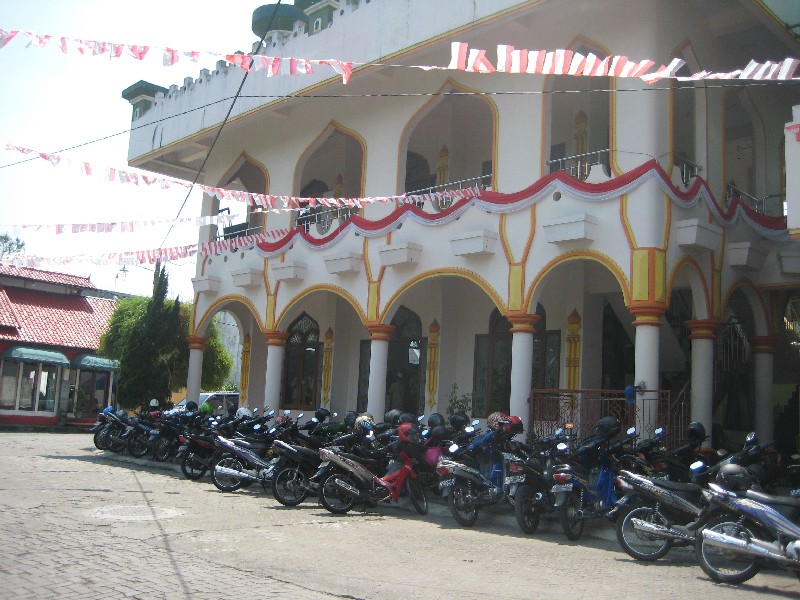
This month in Indonesia is the season of Ramadhan, the most holy of month for followers of the Muslim religion. In Yogyakarta Central Java, is the Koran belt of Indonesia where the density of mosques is greater than one per square kilometer?
                          Friday prayers at the local Mosque

 
Generally Ramadham is a quiet month of reflection. Lebaran, the holiday period immediately after Ramadham where people like to return to their birth place a celebrate by giving presents.


. During this time I have been helping a number of European university students who are undertaking post graduate research in Yogyakarta.


The problems they face in undertaking controversial research on violence towards women, self government in Papua and various government policy issues is in getting information and identifying people who are prepared to talk about these subjects.


The European academics that I have been talking to have been so well trained that they have not learnt to be street smart and worldly. They planned and timed their research studies in Indonesia completely unaware of how the month of Ramadham would have on their activities.
                          Tourists oblivious to Ramadhan

 
How does the month of Ramadhan impact on an expatriate


Like Christianity The Muslim religion has both a religious and social and political aspects. In the West our media had reported widely on the political aspects of the Moslem religion as anarchic acts by some followers have captured our attention.


Here in Indonesia and in Java particularly where the overwhelming majority of the population practice the Moslem religion. Each day the call to prayer, amplified over a loudspeaker system is hard to ignore as are the rather large gatherings of men at the mosques at midday on Fridays. Apart from these noticeable acts few of us in the west know very little detail of the fasting month of Ramadhan.
While I had lived in Jakarta some years ago I never felt the impact of Ramadham .
 Here in Yogyakarta, no one can escape the influence of Ramadan.
 Because people fast between 4.30 am and 6.pm most restaurants and small food stalls are closed during the day.
                          Food stalls by the university closed

 
To find something to eat for lunch one has to hunt around for a Chinese Restaurant. While you can buy alcohol the shelves stocking it are covered with paper or cloth to avoid temptation.


A few days ago it was raining and we felt like having some Lamb and a bottle of red wine. We rode the motor bike through teaming rain along roads that were like rivers six inches deep on a mission for wine .

Arriving at the specialist shop dripping wet, we asked for a bottle of wine. The shop assistant replied that they do not sell wine during Ramadham.
And that was that.!


The usually crowded streets are less crowded, no one smokes between the fasting hours and as a consequence the motorbike riders and car drivers are abnormally frustrated by the self deprivation of food and cigarettes. The increase in the number of accidents and near misses makes one extra cautious.

At work the staff are either lethargic, unmotivated or not at the office at all.

There does not seem any enthusiasm to begin new projects and when I suggest a meeting with villages I am told it will be better to wait until Ramadhan is over.
                      
                        Waiting three hours for a village meeting

 
There are exceptions .Last week we were visiting a village to inspect new Goat houses that have been recently constructed. It was a long day without eating and we had to wait for three hours for a meeting with farmers as they were still out in the fields cutting grass due to the overnight and early morning rain.
                        Hani and one of his new goat houses
The meeting began at 4.00pm and dragged on into the evening. However at sunset, a few minutes before 6.00pm we heard the call to prayer from a number of Mosques, then food began to appear. The local Muslim villagers were sensitive to our need to eat and appreciated out constraint during the day even though we had no access to food even if we desired it.
                                Three day old goats
The food presented was both abundant and delicious and better than the usual village food. Of course as the eating began so did the smoking and within a few minutes we were all sitting in a fog of cigarette smoke.
                              Breaking the fast in a village

 
Back in Yogyakarta I have noticed a several men walking naked along the road and one sitting cross legged on the side of the road meditating. At this time a wide range of different behaviour is acceptable as the spirit moves people in different ways. In addition people discipline themselves not to have arguments or to think badly of other people as those selfish acts will nullify their cleansing behaviour of prayer and self sacrifice for the day.


By late afternoon numerous temporary food stalls spring up along the main roads waiting for the six o’clock swill as fasting for the day ends. The stalls sell fruit and sweet drinks for those feeling dehydrated by 14 hours of abstinence.


So far it has been quiet apart from loudspeakers calling the faithful to prayer . The first call is at 4.30 am, then at midday , then at 3.00 pm and at 6.00pm.


One evening around 6.00 pm I noted that there were hardly any people at the supermarket and when I enquired I was told that it is full moon and most people were celebrating at home or at the mosque.


As the fasting month Ramadhan is coming to an end and the joyous holiday period of Lebaran is a bout to begin the shops are displaying gift packs over one meter high filled with sweets, biscuits and other temptations.
                             Gift packs for Lebaran

 
This month every wage earner receives and additional month’s salary known as the Lebaran bonus. This is the first day of the three day Lebaran holiday that stretches out to two weeks was marked by an almost complete absence of people on the streets, the supermarkets were closed and almost all other shops and businesses as well.


Thank god the circle K store that sells beer was open. I noticed that the paper covering the beer had been removed from the glass door of the freezer cabinet.


The beggars on the street corners next to the traffic lights who are always there have grown in number and instead of a plastic cup for donation s they have large cardboard boxes as Ramadham is the season where the faithful are obliged to give.
                        Even beggars go to sleep during the day
During the holidays people return to their home towns to celebrate with their families and the airports, train and bust stations are bursting with people with boxes of gifts to take home to their families.


In order to reduce congestion, trucks are banned from the roadways except those carrying essential good such as food, cooking oil, gas and medical supplies. These trucks are only permitted to travel between 7.00 pm and 7.00 am.


Consequently the businesses that require supplies that have to be transported are closed for two weeks as well.
                        normally bustling furniture businesses closed

 
One has to be careful not to treat the followers of Islam as one unified homogeneous group. Like football fans in Australia during the finals. While to the outsider they may appear on mass to be all the same when in fact they are not.


Each football fan is usually fiercely loyal to one team and can only see football in terms of club colours. As their scarves testify; the blue and whites stick together and make rude gestures to the followers of the red and white scarf wearers on the way to the game, during the game and on the trains following the game.


Likewise in Indonesian the Muslim religion is like Christianity in that it is composed of many different sub cultures and is not uniform in either the belief or behavioral practice.


The late President Suharto during his presidency of 30 years banned the wearing of the Hijab largely because he did not want to face a united political force of Islam while dealing with other unified groups such as those in Ache, Papua and East Timor as well as big business in Jakarta


It is only when the Muslim population feels threatened by either verbal statements or political actions like those proposed by Pastor Terry Jones that they can put their differences to one side and begin to act as a united political force.


As the vast majority of Muslim adherents are tolerant to other religions as we also need to be tolerant to them. Some right and left wing extremists in Australia in their ignorance of the Muslim religion make statements that many Muslims find offensive and often these comments serve to weaken the tolerance of Muslims to the west.


The words and possible actions of Pastor Jones have reached the ears of the President of Indonesia.


The President said that if the burning of copies of the Koran takes place it will be a disaster for the planet. Is this the truth?


Wednesday, July 7, 2010

I left my harp in Sam Crabs Disco


This is my memory of a joke about San Francisco and Tony Bennett. In the city of crabs you can have them boiled fried or baked together with clam chowder in a hollowed out gigantic bread roll.

I attended a wedding between a French Champagne salesman and an Iranian World Bank worker and took in the sights of San Francisco as well.

   
Coming from a hot Indonesian climate and a people centered community into the chilly society of hardheaded capitalism was indeed a reality check

Arriving at twilight in a long northerly arc from Asia, snow capped mountains appeared in the distance, then the sun dried soil came into view, coming down to the coastline that defines the USA gave us reference points from the air.
The city seems to sprawl over bays with the land connected by many bridges.


Once on the ground there was an endless wait at immigration while our documents were checked, fingers and thumbs on both hand scanned and our faces photographed. Then surprisingly straight through customs with out even a glance of our belongings.
I have never seen so many people in wheel chairs queuing at immigration!


I podered the popularity of wheelchairs. Is because of the anticipated long queues or a tactic to get a seat with good leg room?

As they say in the states we checked in to the King George hotel on the corner of Mason and Geary. A cute 8 story old fashioned homely place. After a sip of wine I was fast asleep


. Some time in the night I was awoken by police car sirens and flashing lights. It was nothing to do with us just the normal Saturday night drunks and drug addicts.


Next morning when it was just light I went exploring. I remember being advised not to walk one way but I could not remember which way. So I set off in the clear morning air across the street past he corner Diner and along Geary street. I had only gone one block when I noticed a police car pull up with another close behind, The female Hispanic police officer gave orders to someone behind me to stop. A derelict with a dog. The four cops spread out and asked me to move out of the way. This poor wretch and his dog were interrogated while on the next corner there were two police cars blocking the road and a policeman was interrogating a guy sitting in the gutter with his wheel chair near by. I have no idea what was going on. The scene was like looking in to the future of the lives of some of the delinquent students I have taught.


Walking on there were a few blacks sleeping on the pavement and a few crazies wanting to sell me some broken down electronic gear. There was a blond women of 40 + drinking some amber fluid from a water bottle while she was chatting to a large African American guy. A couple of hookers passed. Well, I presumed they were hookers as they had on very short dresses on this somewhat fresh Sunday morning.


I managed to get back to the hotel after several polite beggars hustling me for money. My Indonesian rupiah would not have done much for them so I did not respond.

The city straddles a hill with a monument to Christopher Columbus on the top.


. The hippy suburb of Haight, pronounced 8 evolved in the sixties as the hippy movement seemed to migrate to San Francisco with flowers in their hair and LSD in their system. Today it is still vibrant although the fashions have changed somewhat. The people look a little immature and “Punkish” as they are trying to emulate the protestors of the sixties who were protesting about the war in Vietnam and the excesses of Capitalism. Now these pimple faced, comfortable middle class kids have nothing to rebel against except their parents and looking at the way they dress I guess that they have been successful .

Then there is Castro, the Gay suburb. Specialty shops with names like "rock hard" and "hand job" stand out in a well manicured street of cute houses and neatly trimmed hedges. What was thought of a radical in the sixties in now common place. There are shops full of glass bongs and the weed to go with them You can even buy mouth spray that enables you to speak like a gay person! I thought about buying some for Alan Jones.

But he would never use it in public.

“Sitting on the dock of the bay” watching the world go by was written Lou Reed Reed .

One of the most popular songs written about San Francisco. I am sure you knew that. But did you know he received electroconvulsive therapy in his teen years to "cure" homosexual behavior?

In an interview, Reed said of the experience:


“They put the thing down your throat so you don't swallow your tongue, and they put electrodes on your head. That's what was recommended in Rockland County to discourage homosexual feelings. The effect is that you lose your memory and become a vegetable. You can't read a book because you get to page 17 and have to go right back to page one again.” They should have tried that on Alan !

. The sun bleached landscape of white concrete is chilled by a stiff westerly breeze as tourists scurry from one tacky bayside stall to another down at “ Fisherman’s Warf” . Looking back up the hill Pete Seger’s song comes to mind “Little boxes on the hill side little boxes in the bay all made of ticky tacky all look just the same”


Being earthquake prone there are few high buildings and an absence of tall trees


One cannot help to be impressed with the cable cars.


The cable car, an ingenious carriage of the 18th century attaches itself or grips an underground cable that pulls it up the steep hills and down the other side to the bay.


The operator of the cable car is called a grip man, quite a skilful job as only 30% of those who attend the training course pass. They have to grip and release the cable at certain points where several cables cross each other. Not being able to reverse when they come to the end of their destination they are pushed by hand on to a round table top set into the road and then the tabletop and the car are rotated 360 degrees and pushed back onto the track ready for the next load of passengers.
Walking the streets of San Francisco at 6 30 in the morning is cold, the homeless stand out of the wind shaking their cardboard cups. Carpet under felt seems to be the product of choice of these lost people who sleep out in the cold. They are mainly African Americans who have chosen to be homeless or have become homeless through drug addiction, unemployment, poor school grades or just inadequate coping mechanisms, in what appears to be a society of abundance.


Television is less than inspiring. The main story today is a closed freeway with power lines down across the road. This is a 15 minute story about nothing; containing a mountain of information about taking an alternative route “We don’t know as yet whether the power line are a live or not ,we will update you as soon as it becomes clear” The ads begin; lawyers prospecting for business about a drug that may cause health problems ,urging anyone who has taken the drug while pregnant to contact them to learn what their rights are”

Then the weather so detailed and so well explained that by the end of the report you have forgotten what the temperature is going to be today. So much advice about dressing ,”the secret is layers, so that you can peel back as the sun becomes warm;”
More ads about some silly belt that exercises your abdominal muscles or abs. This karate black belt gadget apparently works 600% better than doing sit ups. Talk about information overload?


I can understand why some Americans have psychological illnesses. Watching the TV ads makes you feel inadequate, you are either too fat, too skinny, too rich or too poor. There seems to be a product for every condition that you think you suffer from, and” it is so cheap, such a good investment that you can sleep well knowing that you have made the right purchase decision.”


May be I should buy that gay mouth spray ? Oh ,I am not sure…… does it come with an American accent ? Can you get it with a Jewish accent?? who would I give it too ?…. It is all too hard …. I am so confused. I had better go and ask my shrink!


This is a city of 800,000 people. not to mention the 6.5 million who live in the burbs around the expansive bay. San Francisco is the closest port to China.
The first Chinese arrived in the 1850’s to do what they do best ; look for gold.


The bridge named The Golden Gate completed in 1937 and painted(lucky) red not only has served as a beacon for latter day immigrants from China who are looking for a better life but is also used to transport cars, trucks and busses across the bay.
The most recent arrivals look for work as cleaners in hotels and live in a bustling Chinatown in the heart of the city. Looking up at the shabby apartment blocks, their underwear hangs unashamedly from the windows while they are scurrying about trying to make a dollar.


Americans have a wonderful way with words.


Superlatives dominate the sentences.


Starbucks, what a name! It is the embodiment of American cultural values; Flying the flag of capitalism and the American dream all in one word. The idea, that it is possible for everyone in America to be rich, successful and possibly famous comes unstuck when you walk the streets of San Francisco at dawn.
The scavengers are up and about. The pigeons forage on the pavements and are so fat that they can barely fly 20 meters in one stretch. The industrious Chinese, old men and women carry their plastic bags from one garbage bin to another and with rubber gloves and protective arm covers reach into the bowels of the bins retrieving bottles and cans and hobble with their loads to the street corner. The corner of Mason and Geary is the mini depot on the pavement for 20 large plastic garbage bags where a fellow countryman arrives in a mini truck to collect them.


The less industrious homeless, African American males pick over the


Garbage looking for cigarette butts and discarded Starbucks coffee cups that they can use when begging.


This morning I saw a police pickup truck cruising the streets. It was filled with supermarket trolleys, bits of clothing and assorted junk.

They too were scavenging for people sleeping on the pavement.


They spotted a figure wrapped in felt and plastic in the doorway of Maceys’ department store. The police truck quietly pulled up and the officers got out and photographed the sleeping bundle before waking it up.
They guy was Caucasian in his forties. Filthy. He got to his feet and gathered up his belongings and stuffed them in a bag while one policeman was writing out what looked like a parking infringement ticket.
The formality of getting the vagrant to sign the ticket seemed to me a pathetic attempt at good manners in what appeared to be a hopeless situation.
The police truck and the vagrant moved on and went their separate ways as a large council water truck came by spraying the street clean and removing the evidence of failure in the system.


Now the suits and the more prosperous people are on their way to work , each sipping their Starbucks coffee while trailing their office bags on wheels.

Trucks arrive supplying the stores with their daily goods while the early department store workers arrange their apparel for the day.
By 9.00am the commercial activity of the city is fully functioning. Buying and selling, eating breakfast at the hundreds of diners dotting


City. The pavements are clean the windows washed and the brass is shining and happiness prevails under the fluttering flags of the stars and stripes.
God save America !